We are innovative, ambitious and ready for challenges! Hire Us






The EdTech Piracy Problem And How It’s Quietly Killing Course Revenue
If you run an online education platform or sell courses for a living, here is a question worth sitting with: EdTech piracy bothering you? How many people accessed your content last month without paying for it?
If you cannot answer that with confidence, the number is almost certainly higher than you think.
EdTech piracy is not a fringe problem. It is not something that happens only to the biggest platforms. It is a structured, fast-moving, and largely invisible drain on course revenue and for most platforms, it is growing quietly in the background while teams focus on acquisition, retention, and product.
This blog breaks down how it actually works, why Telegram is at the centre of it, and what an effective response looks like.
The Scale of the Problem: EdTech Piracy
India’s e-learning sector lost an estimated ₹2,000 crore to EdTech piracy in 2024 alone. That figure, drawn from an industry study published the same year, is not an anomaly, it is the consequence of a piracy infrastructure that has been building steadily for years, largely unchallenged.
Thousands of course piracy groups currently operate on Telegram. Of those, most of them have 10,000 members each. These are not informal chat groups sharing the odd PDF. They are organised distribution networks, operating at scale, with admins who actively curate, update, and re-upload content as takedowns occur.
The content most commonly targeted? Competitive exam preparation, which accounts for 40 per cent of all academic content consumption followed by programming, data science, and professional skills courses. These are, not coincidentally, the highest-value categories in the market.
Why Telegram Is the Platform of Choice for EdTech Piracy
Telegram crossed 1 billion monthly active users in March 2025. India is its largest market, with 104 million users. The platform is fast, free, and critically built in a way that makes large-scale content distribution easy and moderation difficult.
Channels can hold unlimited subscribers. Files of up to 2 GB can be shared directly. Groups can scale to hundreds of thousands of members. Admins can operate anonymously. Content, once shared, can be forwarded instantly across multiple channels before a single takedown request has been drafted.
This is the infrastructure that pirates have built their EdTech distribution model on. A single pirated course once uploaded to a Telegram channel with 50,000 subscribers reaches more people in an hour than most paid newsletters do in a month.
What makes this particularly difficult to address is the speed of recovery. When a channel is removed, a replacement is typically live within hours. Content is mirrored, renamed, split across multiple channels, and re-shared. Without systematic monitoring and channel-level enforcement, the takedown of a single link achieves very little in many cases.
How the EdTech Piracy Cycle Actually Works
Understanding the mechanics matters, because most platforms underestimate how organised this ecosystem is.
It typically begins with a breach at the source. A paid student records a live session, screen-captures a video lecture, or extracts a downloadable resource. That content is then shared, either directly in a Telegram group or uploaded to a channel operated by a piracy admin.
From there, the distribution is automated and rapid:
- EdTech piracy channels re-upload content as soon as new modules or batches are released
- Some channels offer “subscriptions” to pirated course libraries, monetising stolen content through Telegram’s own payment tools or external UPI links
- Admins use bots to monitor for new content and auto-post it to multiple channels simultaneously
- When a channel is taken down, a backup channel already seeded with subscribers goes live immediately
The result is that many learners, particularly in Tier 2 and Tier 3 cities where affordability is a genuine barrier, never have a reason to pay. The pirated version is available before they have even considered the official platform.
The Revenue Impact Goes Beyond the Obvious
The most immediate impact is lost subscription revenue when it comes to EdTech piracy. But the damage extends further than that.
Pricing power erodes. When pirated versions are freely available, platforms face pressure to reduce prices or offer aggressive discounts simply to compete with free. Over time, this undermines the perceived value of the product itself.
Instructor trust declines. Independent educators who build and sell their own courses through platforms, or directly to learners, are often the hardest hit. For many, a single course represents months of work. Watching it circulate freely on Telegram while paying subscribers dwindle is both a financial and a motivational blow.
Acquisition costs rise. If a significant portion of your target audience has already accessed your content for free, converting them into paid users becomes structurally harder and more expensive.
Brand credibility suffers. Pirated content is often clipped, edited, and redistributed without context. This affects how the platform or instructor is perceived and can create reputational risk that compounds over time.
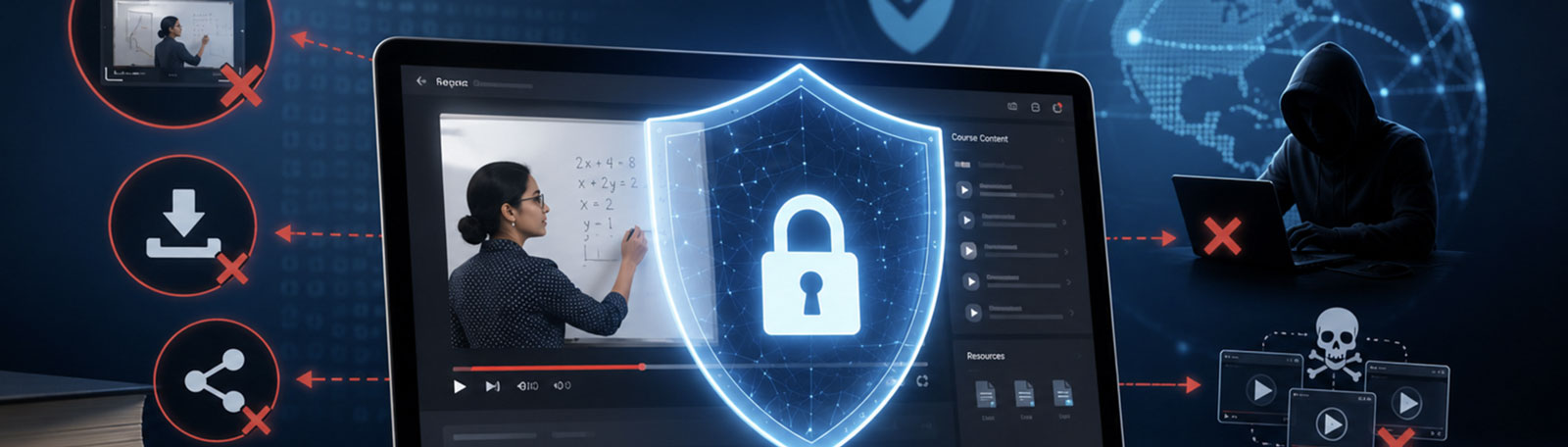
What Effective EdTech Piracy Protection Looks Like
The platforms that are winning against piracy are not simply responding faster. They are operating at a different level of sophistication.
Effective protection involves:
Proactive surveillance across Telegram, YouTube, and beyond. Piracy does not stay in one place. Stolen EdTech content moves across Telegram channels, YouTube uploads, rogue websites, and peer-to-peer networks. Monitoring must follow the content, not wait for it to be reported.
Channel termination, not just link removal. Removing a single infringing link from a Telegram channel with 80,000 subscribers is the equivalent of pulling one item off a shelf while the store remains open. The goal must be the termination of the channel itself which requires documented evidence, platform-specific legal frameworks, and consistent follow-through.
Pattern tracking and repeat infringer identification. Pirates do not operate once and disappear. They are repeat actors with recognisable patterns, the same usernames, the same content structures, the same recovery playbooks. Tracking these patterns allows enforcement to move faster and more precisely than the pirates themselves.
The Conversation That Needs to Happen
EdTech piracy rarely makes headlines the way film piracy does. There is no dramatic release-day leak, no front-page story about a blockbuster being on torrent sites before it reaches cinemas.
Instead, it is slow and steady. A platform loses 200 potential subscribers this month, 500 next month, and 1,000 the month after. The revenue never shows up on a dashboard as “lost to piracy”, it simply never arrives.
That is precisely what makes it so dangerous, and precisely why so few platforms have addressed it with the seriousness it deserves.
The EdTech market in India is projected to reach $10.1 billion by 2030. The platforms that will capture the most value in that market are the ones that protect it effectively enough to build a sustainable revenue model around it.
Protect What You Build
At BLOCK X, we work with EdTech platforms, independent course creators, and digital learning businesses to detect, monitor, and eliminate piracy across Telegram, YouTube, and other distribution channels.
Our approach combines real-time surveillance, channel-level enforcement, and legal escalation where required, ensuring that your content reaches paying learners, not piracy networks.
If you would like to understand the scale of exposure your platform currently faces, contact us.
Recent Blogs