We are innovative, ambitious and ready for challenges! Hire Us





The Raanjhanaa and AI in Movie: When Ownership Meets AI
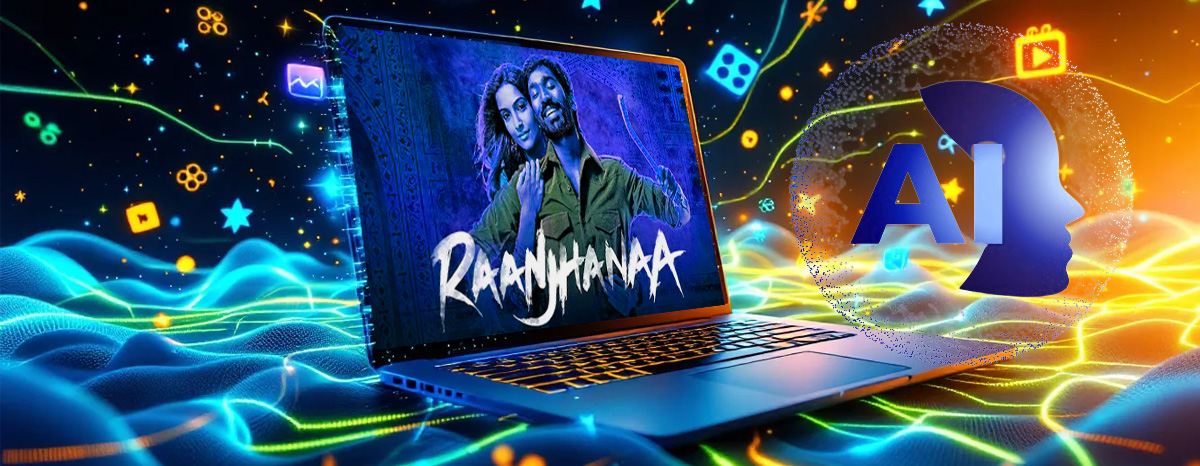
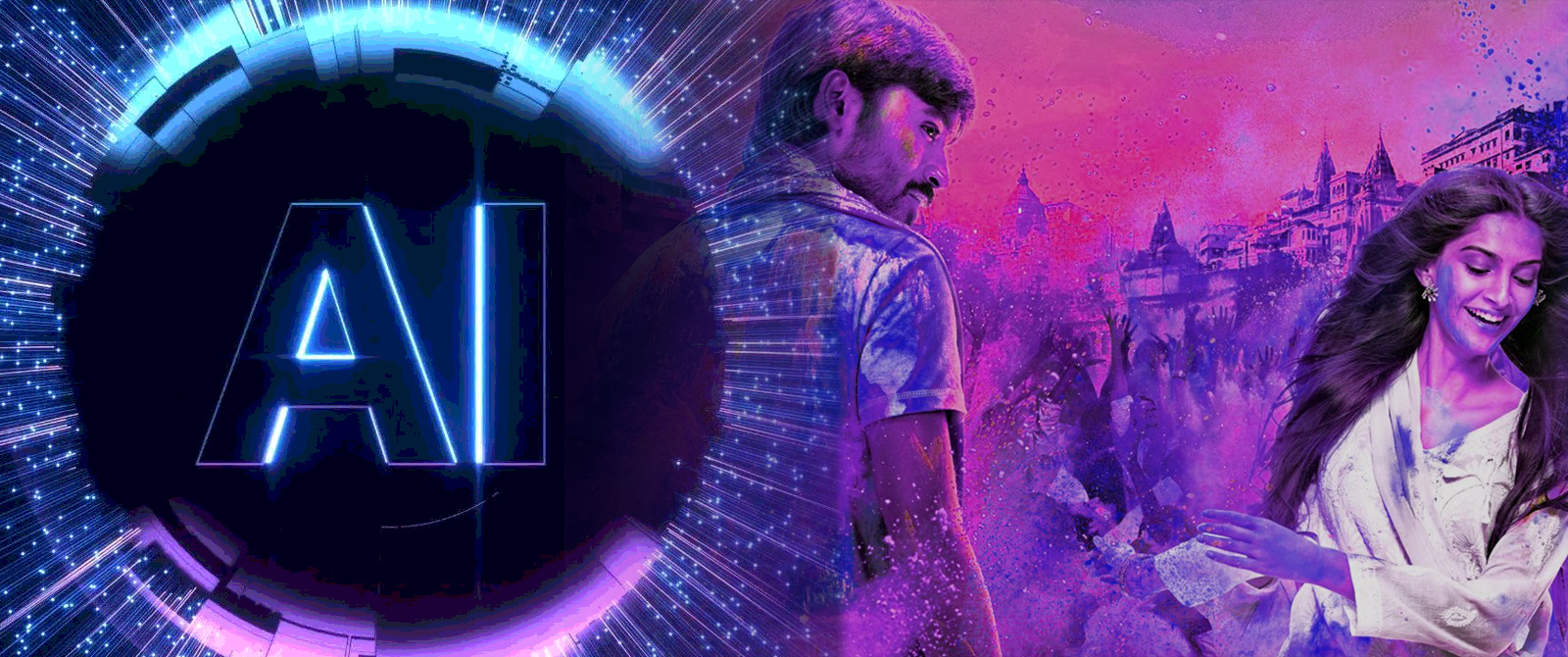
When a beloved film like Raanjhanaa gets a second theatrical release, you’d expect nostalgia, not controversy, but unfortunately, that’s exactly what the fans got with the use of AI in movie. With the production house Eros International choosing to re-release the film’s Tamil version (Ambikapathy) featuring an AI-generated “happy ending,” the creative community is in uproar.
Director Aanand L. Rai, actor Dhanush, and the original writer have all publicly condemned the move, calling it a betrayal of the film’s essence. But here’s the twist: legally, the production house holds the rights: every frame, every line, every possible reinterpretation is owned by the production company.
In an age where AI is rewriting not just scripts but legacies, who truly owns a story when it comes to this case of using AI in movie? And where does creative control end when legal ownership begins? As an anti-piracy firm invested in protecting content integrity, BLOCK X unpacks this case analysing the legal point of view.
Law Supporting Eros International
Under Indian Copyright Law (specifically Section 2(d)), the producer is legally considered the author of a cinematographic film, not the director and here, Eros International holds all the rights of the movie. The copyright owner, in this case, Eros International, holds the exclusive right to adapt, reproduce, and communicate the work to the public under Section 14 of the Copyright Act.
Directors generally do not possess moral rights under Section 57 unless they are also credited as an author in another capacity, such as a screenwriter or performer. This means Rai cannot legally claim rights over the film unless specific rights were retained in his contract.
Eros has stated that using AI in movie is simply a means to connect with evolving technology and there are many instances where AI has been used in the movies recently, though this is the first time AI has been used to alter a movie’s ending. The production house describes the AI-assisted ending as a “respectful creative reinterpretation”.
Director Aanand L Rai has publicly explained his disagreement, stating he cannot “wrap his head around” the re-release. He emphasised the importance of being careful when “signing the dotted line” and said, “Don’t use AI to distort the past!”. This highlights his concern for the original artistic vision and integrity of his work. He has stated that the alteration was made without his knowledge or consent.
The actor of the movie, Dhanush has also posted a public statement on his social media conveying his disagreement with the AI-altered release.
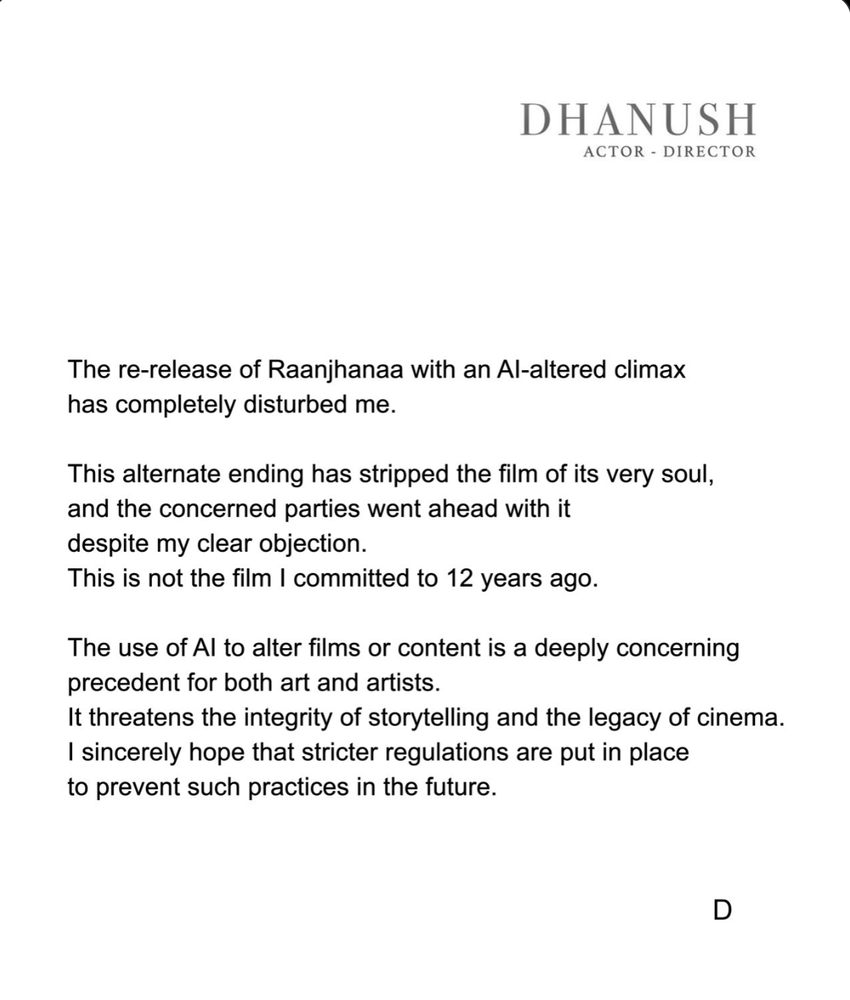
The controversy brings into focus broader concerns about who controls the final cut and what counts as “authorship” in the age of using AI in movie. It questions whether a story still represents the director’s vision if it can be altered by AI. The case signals a deeper debate about AI’s role in art, authorship, and ownership, and raises the question of whether commercial stakeholders should be allowed to override original artistic expression using technology, even if legally permitted.
This is not just a question of rights, but a deeper case of ethics and the morality of cinema. Some films are crafted to leave a lasting, emotional impact rooted in the vision of their creators. Rewriting such stories by using AI in movie, however legal it may be, risks diluting their essence. When the core message of a film is altered, the soul of the narrative is compromised. Cinema is not just content, it’s art and that’s a debate that could go on and on.
AI in Movie: The Copyright Scenario
Now coming to the protection of AI generated works, if there is enough human intervention involved, it can be protected under copyrights. Under current Indian law, AI in movie cannot be considered an author, nor can the AI’s developer typically claim copyright unless explicitly stated in terms of use. While a simple prompt is insufficient for copyright, significant human involvement beyond mechanical actions should qualify for protection, offering a framework suitable for India’s evolving legal landscape.
The Raanjhanaa case highlights the need to revisit legal frameworks and ethical boundaries in the creative industry as AI tools become more powerful. This would bring a better clarity in the legal frameworks and the use of AI in movie around it when it comes to creativity and innovation. It is high time our law includes such clauses.
To know more about how BLOCK X can protect your content, contact us.
Credits: Sri Vasavi Devi (Representative of BLOCK X)
Recent Blogs